 dan
The funnel guide · 20 parts Updated October 2026 · about 60 min read
What Is a Sales Funnel?
A funnel builder's field guide.
What a sales funnel is, the stages, the types, and exactly how I plan, build, track and fix funnels for clients. Plain English, real examples, and a live funnel you can click through.

- 01What is a sales funnel?
- 02Funnel vs website vs landing page
- 03Sales funnel stages
- 04AIDA, TOFU/MOFU/BOFU, flywheel
- 05Types of sales funnels
- 06Is your business ready?
- 07Mapping your funnel
- 08The offer
- 09How to create a sales funnel
- 10Traffic & message match
- 11Opt-in & lead capture pages
- 12Quiz & booking funnels
- 13Sales pages, checkouts & upsells
- 14Funnel tools & builders
- 15Email & SMS follow-up
- 16Tracking: pixels, events, UTMs
- 17Funnel math & analysis
- 18Testing & fixing leaks (CRO)
- 19Sales funnel examples
- 20Mistakes, costs & hiring a builder
On this page
- 01What is a sales funnel?
- 02Funnel vs website vs landing page
- 03Sales funnel stages
- 04AIDA, TOFU/MOFU/BOFU, flywheel
- 05Types of sales funnels
- 06Is your business ready?
- 07Mapping your funnel
- 08The offer
- 09How to create a sales funnel
- 10Traffic & message match
- 11Opt-in & lead capture pages
- 12Quiz & booking funnels
- 13Sales pages, checkouts & upsells
- 14Funnel tools & builders
- 15Email & SMS follow-up
- 16Tracking: pixels, events, UTMs
- 17Funnel math & analysis
- 18Testing & fixing leaks (CRO)
- 19Sales funnel examples
- 20Mistakes, costs & hiring a builder
- +Glossary
- +FAQ
What is a sales funnel?
Here's the plain definition first. Then I'll show you how I actually think about funnels when I build one for a client.
A sales funnel is the step-by-step path a stranger takes to become a paying customer: they notice you, get interested, decide, and buy (then, ideally, buy again). It's called a funnel because many people enter at the top and fewer make it to each next step. A good funnel is built on purpose, so every step has one job and leads clearly to the next.
Every business already has a funnel, whether they built one or not. Someone sees your truck, searches your name, lands on your site, reads a page, calls, gets a quote, and either books or disappears. That's a funnel. Most of the time it's an accidental one, full of holes nobody has measured.
When people hire me to build a funnel, what they're really asking for is to take that accidental path and design it. Decide who comes in, what they see first, what single action they should take, what happens right after, and what follows up when they don't act. Then measure each step so we know exactly where people drop off.
What "funnel" actually means
Outside marketing, a funnel is a cone that's wide at the top and narrow at the bottom. You pour a lot in and a focused stream comes out. In sales the picture is the same. A thousand people might see an ad, a hundred click, thirty fill in a form, ten book a call, and three buy. Every step narrows the group.
- 1,000 see itAd, post, search result
- 100 clickThey land on your page
- 30 opt inForm, quiz or booking
- 10 talk to youCall, demo or visit
- 3 buyCustomers
These numbers are an illustration, not a promise. Real rates depend on your offer, price, market and traffic. But the shape is always true, and it's the reason funnels are so useful: when you can see the shape, you can see where to fix it.
Why the narrowing is a good thing
People panic when they see that most visitors don't buy. They shouldn't. A funnel isn't supposed to convert everyone. It's supposed to filter. The person who isn't a fit should leave quickly and cheaply, and the person who is a fit should feel the path get easier with every step.
The three things every funnel needs
- Traffic: a reliable source of the right people (ads, Google, social, referrals, email).
- A conversion point: a page that asks for one clear action, like booking, buying or opting in.
- Follow-up: what happens after they act, or after they don't (emails, texts, retargeting, a sales call).
If any one of those is missing, it isn't really a funnel. A beautiful landing page with no traffic is a poster in an empty room. Traffic with no follow-up is money leaking out the bottom. Follow-up with no clear offer is just spam.
My working example: ad, opt-in, 3-question quiz, booking and follow-up, with an "under the hood" panel showing the tracking events and automations at each step.
Open the live demoWant me to look at the path your customers take today and point out the leaks? Send me your link.
Email meSales funnel vs marketing funnel vs website vs landing page
These words get thrown around like they mean the same thing. They don't, and mixing them up is how businesses end up paying for the wrong project.
A website is your whole online home with many pages and many jobs. A landing page is one page with one goal. A sales funnel is a planned sequence of steps (often several pages plus emails or texts) that moves one type of visitor toward one purchase. A marketing funnel is the bigger picture of how people discover and warm up to your brand before the sales funnel takes over.
| Website | Landing page | Sales funnel | Marketing funnel | |
|---|---|---|---|---|
| Main job | Explain who you are, serve everyone | Get one action | Turn a lead into a sale | Turn strangers into leads |
| Pages | Many | One | Several steps + follow-up | Content, ads, social, email |
| Navigation | Full menu | Usually none | Only forward | Open |
| Traffic | Everyone | One campaign | One audience | Broad |
| Measured by | Visits, enquiries | Conversion rate | Cost per sale | Reach, leads |
Sales funnel vs marketing funnel
In big companies, marketing owns the top (getting attention, building trust, collecting leads) and sales owns the bottom (calls, demos, closing). That's where the two names come from. In a small business, it's usually one person or one team, so I treat it as one connected path. The marketing funnel fills the sales funnel. If you only fix one half, you just move the bottleneck.
Where a website fits
Your website is still important. It's where people go to check you're real after they see your ad or get your email. But a website tries to serve everyone: job seekers, existing customers, curious browsers, buyers. A funnel serves one person with one problem. That focus is why funnels usually convert better for paid traffic.
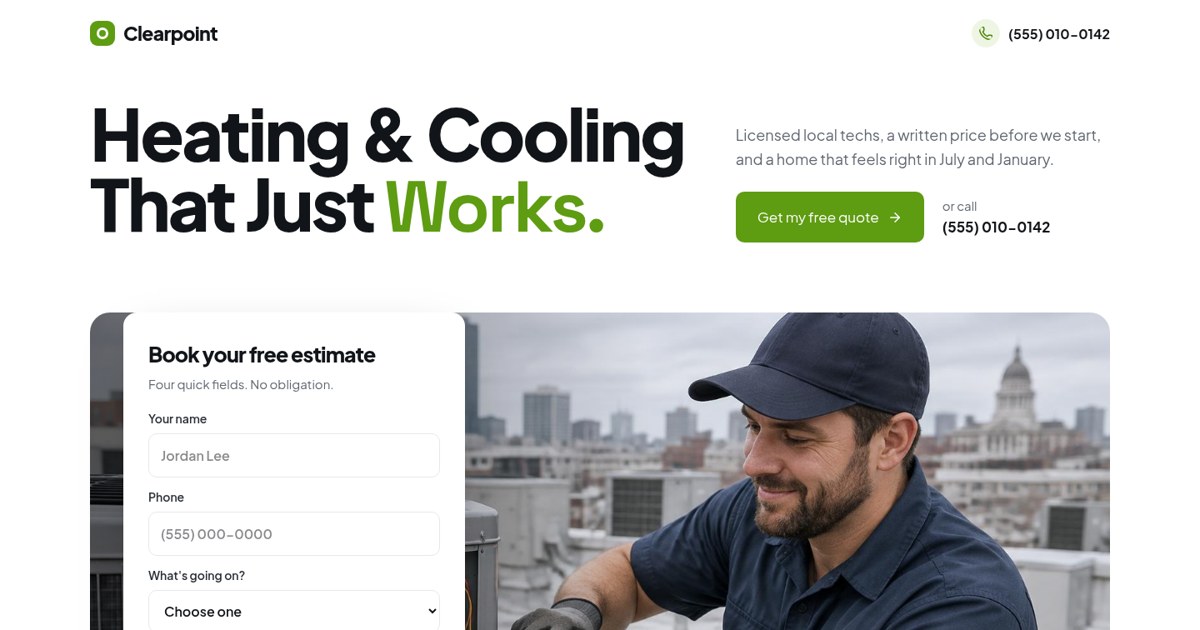
A single-goal page: one estimate form, problem cards that pre-fill it, and no menu to wander off into.
Open the live demo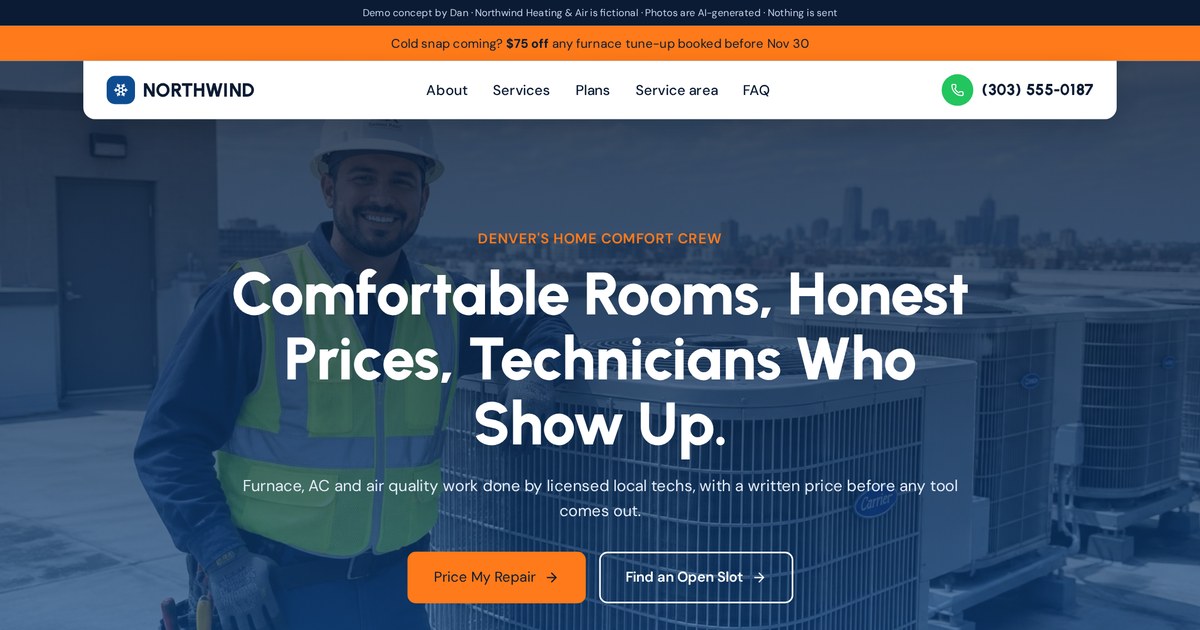
Compare it with a full website for the same niche: services, plans, about, FAQ. Many jobs, many paths.
Open the live demoSo which one do you need?
- Just starting and nobody knows you: a solid website first, so you look real.
- Running ads or a specific promotion: a landing page or funnel for that campaign.
- Selling something with a considered decision (high price, consultation, application): a full funnel with follow-up.
- Already busy but leaking leads: fix the follow-up part of the funnel before anything else.
The stages of a sales funnel
Every framework names the stages a little differently. Here's the version I use with clients, because it maps directly to pages, messages and numbers.
The five main sales funnel stages are Awareness (they discover you), Interest (they want to learn more), Decision (they compare and evaluate), Action (they buy, book or sign up) and Retention (they come back, upgrade or refer). Each stage needs different content and a different next step.
- Awareness"Oh, this exists."
- Interest"Tell me more."
- Decision"Is this the right choice?"
- Action"Okay, let's do it."
- Retention"I'd do that again."
1. Awareness
The person has a problem, or doesn't even know they have one yet. They see an ad, a post, a search result, a friend's recommendation. Your only job here is to be noticed by the right person and earn a click. Clear hooks win. Clever wordplay usually loses.
What I build for this stage: ad creative briefs, short-form hooks, SEO articles like this one, and a landing page headline that matches the ad exactly.
2. Interest
They clicked. Now they're asking, "Is this for me?" This is where most pages lose people, because they talk about the business instead of the visitor's problem. The page should name the problem, show you understand it, and offer a small, low-risk next step.
What I build: opt-in pages, quizzes, calculators, free guides, short videos, and anything that lets a visitor raise their hand without committing to a sale.
3. Decision
Now they're comparing. You against your competitor, against doing nothing, against doing it themselves. They want proof, pricing clarity, and answers to their objections. This is where case studies, real reviews, guarantees and FAQ sections earn their keep.
4. Action
They're ready. Don't make it hard. A short form, a clear booking calendar, a checkout with as few fields as possible, and a confirmation page that tells them exactly what happens next. Every extra click here costs real money.
5. Retention
The most ignored stage, and often the most profitable. A customer who already trusts you is far cheaper to sell to than a stranger. Onboarding emails, review requests, referral offers, maintenance reminders and upgrades all live here.
Matching content to each stage
| Stage | Visitor's question | What works |
|---|---|---|
| Awareness | What is this? | Ads, short videos, SEO articles, social posts |
| Interest | Is it for me? | Landing page, quiz, free guide, calculator |
| Decision | Can I trust it? | Reviews, case studies, pricing, FAQ, guarantee |
| Action | How do I start? | Short form, booking calendar, checkout |
| Retention | Was it worth it? | Onboarding, check-ins, referrals, upsells |
Funnel frameworks: AIDA, TOFU/MOFU/BOFU and the flywheel
You'll hear these acronyms a lot. They're all describing the same journey from slightly different angles. Here's what each one is good for.
AIDA (Attention, Interest, Desire, Action) is a copywriting model for moving a reader through one message. TOFU, MOFU and BOFU (top, middle and bottom of funnel) group your content by how ready someone is to buy. The flywheel is a model that focuses on happy customers feeding new ones through reviews and referrals.
AIDA: the oldest one, still useful
AIDA has been around for over a century. I use it mostly at the page level. A good landing page grabs attention with the headline, builds interest with the problem, creates desire with the outcome and proof, and asks for action with one clear button. If a page feels flat, I usually find one of those four letters missing.
- Attention: a headline that names the visitor's situation in their own words.
- Interest: a few lines that show you understand the problem better than they expected.
- Desire: the outcome, the proof, and what life looks like after.
- Action: one button, one next step, no competing choices.
TOFU, MOFU, BOFU: planning content
This one is better for planning what to make. Top-of-funnel content is for people who are just discovering the problem (like a guide titled "What is a sales funnel?"). Middle-of-funnel content helps people compare options ("ClickFunnels vs GoHighLevel"). Bottom-of-funnel content is for people ready to buy ("Hire a funnel builder", pricing pages, case studies).
| Level | Buyer mindset | Content examples | Ask |
|---|---|---|---|
| TOFU | Learning | Guides, videos, social posts | Read more / subscribe |
| MOFU | Comparing | Case studies, webinars, comparisons, quizzes | Opt in / book a call |
| BOFU | Ready | Pricing, demos, testimonials, offers | Buy / sign / book |
The flywheel
The flywheel says a funnel ends with a customer, then throws them away, which is wasteful. Instead, picture a wheel: you attract, engage and delight customers, and their reviews and referrals spin the wheel faster. I like this model because it forces you to design the retention stage on purpose.
Types of sales funnels (and when to use each)
There's no single "best" funnel. The right one depends on your price, how much trust you need, and how quickly people can decide.
The most common types of sales funnels are lead magnet funnels, quiz funnels, booking or consultation funnels, webinar funnels, tripwire (low-price first offer) funnels, video sales letter funnels, ecommerce product funnels and application funnels. Low-price, simple offers suit short funnels; high-price, considered offers need longer funnels with more trust-building.
| Funnel type | Best for | Steps | Typical price point |
|---|---|---|---|
| Lead magnet | Building an email list | Ad → opt-in → thank-you → emails | Free first |
| Quiz | Personalised offers, services | Ad → quiz → result → offer | Any |
| Booking / consultation | Local services, agencies, coaches | Ad → page → calendar → reminders | Medium to high |
| Webinar | Courses, B2B, high-ticket | Ad → register → live/recorded → offer | High |
| Tripwire | Info products, ecommerce | Ad → cheap offer → upsell | Low first, then higher |
| Video sales letter | Single strong offer | Ad → video page → checkout | Medium |
| Ecommerce | Physical products | Ad → product → cart → upsell | Low to medium |
| Application | Premium, limited offers | Ad → page → application → call | High |
Lead magnet funnel
You trade something genuinely useful (a checklist, guide, template, discount) for an email address, then follow up. Works best when the freebie solves a small part of the bigger problem your paid offer solves. A generic "newsletter signup" is not a lead magnet.
Quiz funnel
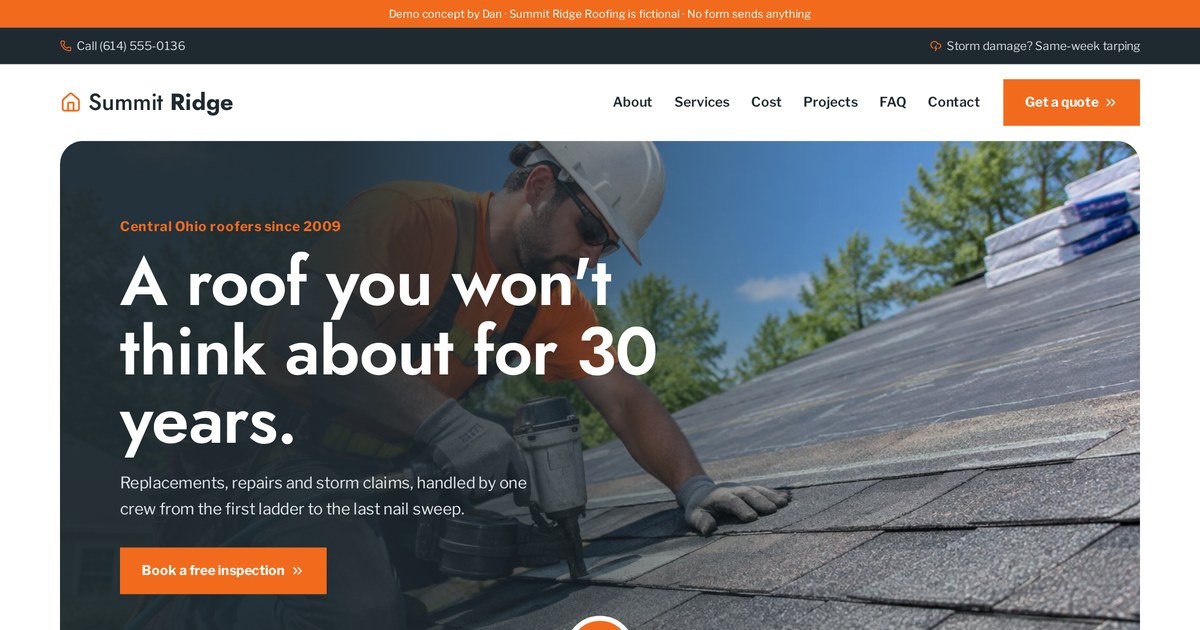
My personal favourite for service businesses. Three to six easy questions, then a personalised result. Quizzes feel like help, not a sales pitch, and every answer tells you something about the lead. My roofing demo uses one to sort homeowners by urgency.
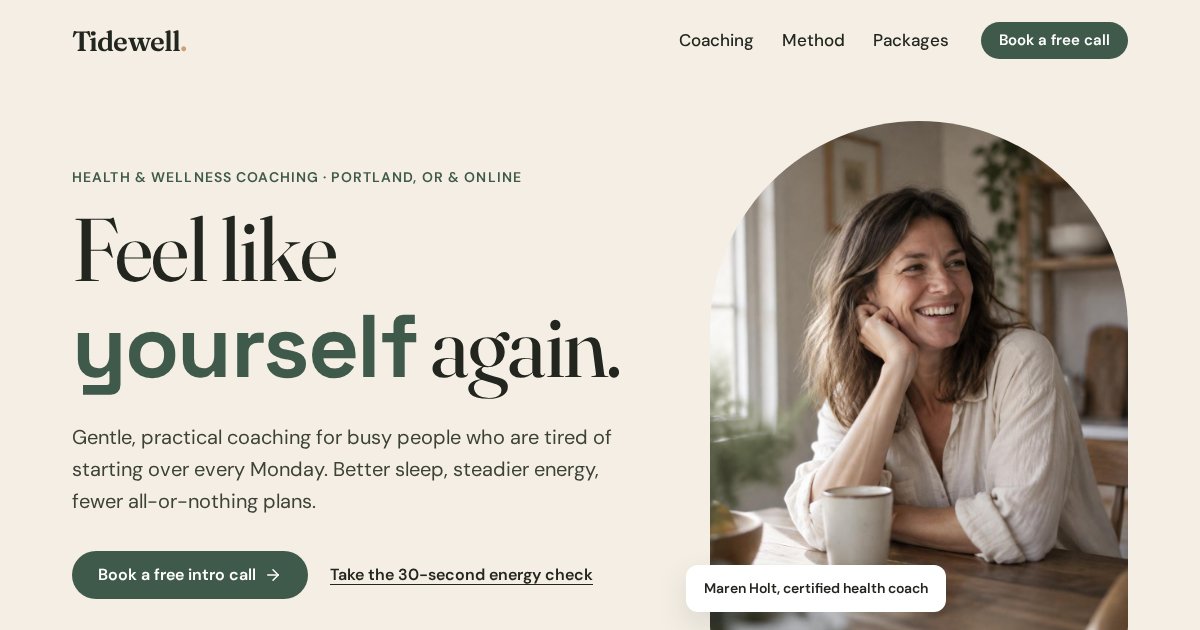
Uses a 3-question "energy check" quiz that leads straight into a booking calendar, a mini quiz funnel inside a website.
Open the live demoBooking funnel
Ad, a focused page, a calendar, and reminders. Simple and effective for dentists, contractors, consultants and clinics. The biggest wins here are usually in the reminders, because no-shows quietly kill booking funnels.
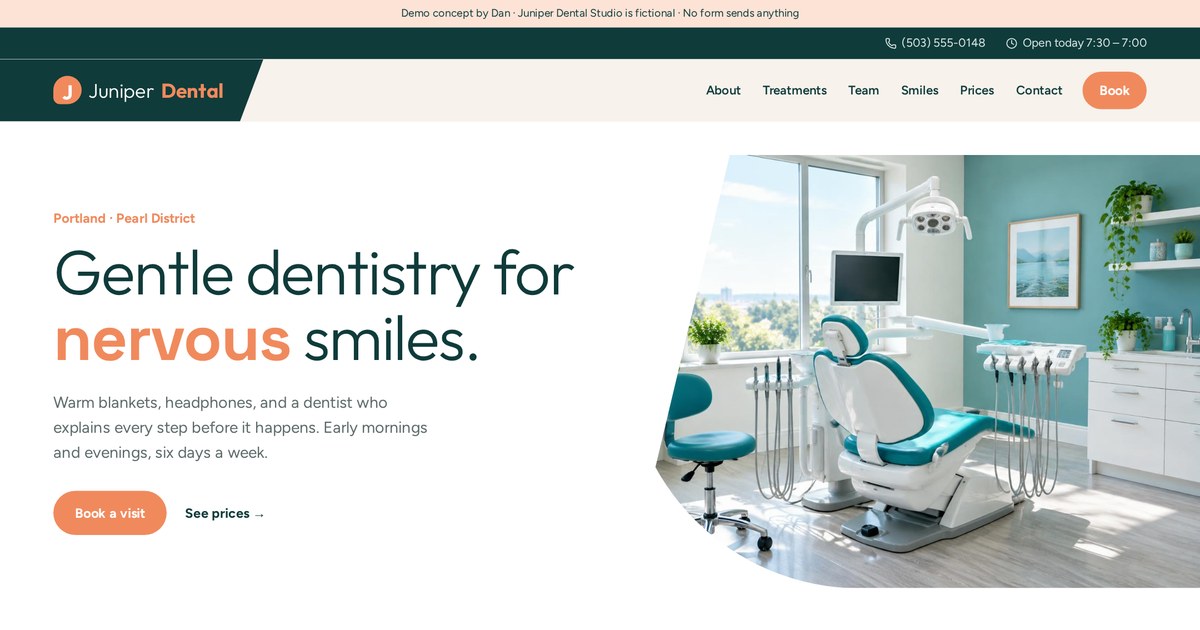
Treatment tabs feed into a short booking form: the path from "what do you offer?" to "book me in" is two clicks.
Open the live demoWebinar and video funnels
For higher prices, people need more time with you before they buy. A webinar or video lets you teach, show proof and handle objections at scale. These funnels need strong follow-up because many registrants won't show up live.
Tripwire and ecommerce funnels
A small, easy first purchase turns a browser into a buyer, which changes how they see you. Then an upsell or bundle raises the order value. Online stores live and die by the cart and checkout steps.
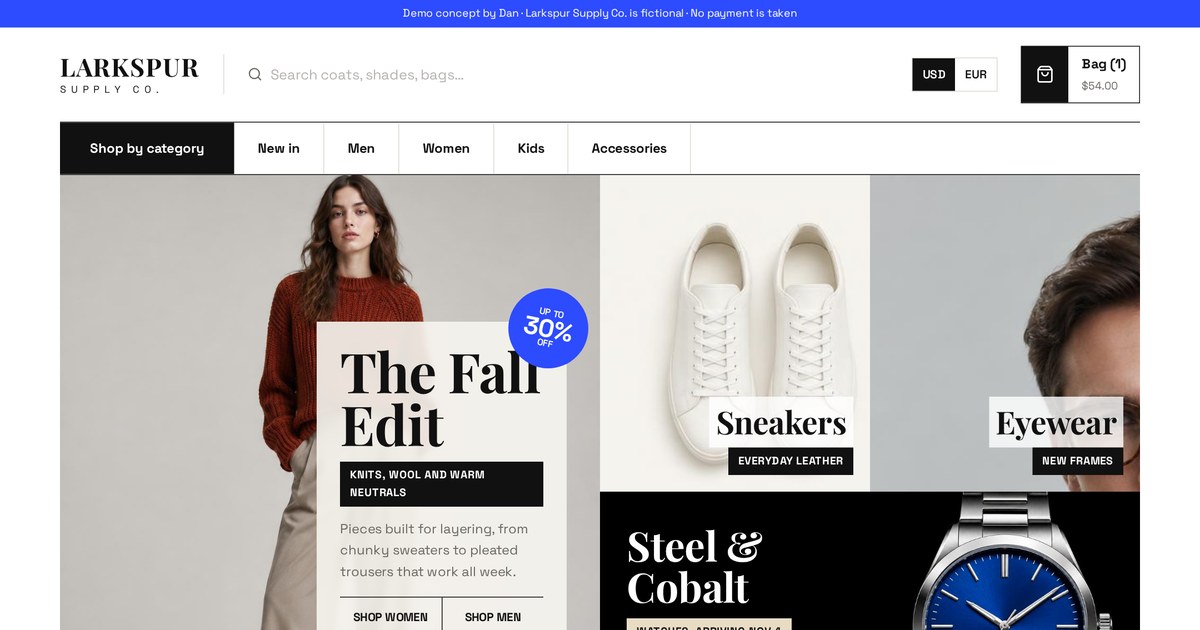
Quick view and a slide-out cart keep shoppers moving forward instead of bouncing between pages.
Open the live demoApplication funnel
For premium offers where you want fewer, better leads. Asking people to apply flips the dynamic: they're now selling themselves to you. Use it only if you genuinely have limited capacity, otherwise it feels like a gimmick.
Is your business ready for a funnel?
Funnels amplify what's already there. If the offer is weak, a funnel just helps more people find out faster. Here's my readiness check before I take a project.
Your business is ready for a sales funnel when you have a clear offer people already buy, you know who your best customer is, you can handle more leads, and you're willing to track the numbers. If you can't describe your offer in one sentence or you've never sold it, fix that first.
My five-question readiness check
- Can you explain what you sell, who it's for and the result in one sentence?
- Has at least a handful of real customers bought it and been happy?
- Do you know roughly what a customer is worth to you over time?
- If leads doubled next month, could you actually serve them?
- Will someone check the numbers every week and act on them?
If you answered no to the first two, a funnel is premature. You need conversations, not automation. Talk to twenty potential customers, sell it by hand, and listen to the words they use. Those words become your headlines later.
If you answered no to question three, that's fixable in an afternoon. Take your average sale, multiply by how many times a typical customer buys, and you have a rough customer value. That number tells you how much you can afford to spend getting one customer.
The numbers you need before building
| Number | Why it matters | Rough way to get it |
|---|---|---|
| Average sale value | Sets your ad budget ceiling | Total sales ÷ number of sales |
| Close rate | Shows how good your sales step is | Customers ÷ qualified leads |
| Customer value over time | Tells you what a customer is really worth | Average sale × repeat purchases |
| Capacity | Stops you buying leads you can't serve | Jobs or clients you can take per month |
Not sure if you're ready? Email me your offer in one sentence and I'll tell you honestly.
Email meMapping your funnel before you build
I never open a page builder first. I open a blank page and draw boxes and arrows. That map saves weeks of rebuilding later.
A funnel map is a simple diagram showing every step a lead goes through: the traffic source, each page, each form, every email or text, and what happens if they say yes or no at each point. Drawing it first shows gaps, dead ends and missing follow-ups before you spend money building.
Start with one customer, not everyone
Pick your best customer type. Not "homeowners", but "homeowners in older houses who just noticed a leak after a storm." Write down what they're worried about, what they search, what they'd be embarrassed to ask, and what makes them pick up the phone. The funnel is built for that one person.
Map the journey in boxes
- Traffic sourceWhere do they come from?
- First pageWhat do they see in 3 seconds?
- Conversion stepForm, quiz, booking, checkout
- Thank-you pageWhat happens next, clearly
- Follow-upEmails, texts, calls, retargeting
For each box, I write three things: the goal of that step, the message the visitor sees, and the number I'll measure. If I can't write a measurable number for a step, the step is either unnecessary or not designed yet.
Draw the "no" paths too
Most people only map the happy path. But most leads say no, or not now. What happens when someone fills the quiz but doesn't book? When they book but don't show? When they get a quote and go quiet? Those branches are where the money hides.
- Opted in but didn't book: a 3 to 5 email or text sequence with an easier next step.
- Booked but didn't show: same-day reminder, then a reschedule link.
- Got a quote, no reply: a check-in after a few days, then an answer to the most common objection.
- Bought: onboarding, a review request, and a referral ask at the right moment.
Wireframe the pages
Once the map makes sense, I sketch each page as grey boxes: headline, proof, form, FAQ. No colours, no photos. It keeps the conversation on structure and message. Clients often find the real problem in this stage, like realising their offer has three prices and nobody understands which to pick.
The offer: what actually gets people to say yes
Design matters. Copy matters. But the offer matters most. I've seen ugly pages with great offers beat beautiful pages with weak ones every time.
An offer is the complete deal you put in front of someone: what they get, the result it delivers, the price, how risky it feels, and why they should act now. A strong offer is specific, easy to understand, clearly worth more than it costs, and removes as much risk as possible for the buyer.
The parts of a strong offer
- The outcome: what changes for them, in plain words ("a dry roof before the next storm").
- The vehicle: what you actually do or deliver to get them there.
- The proof: why they should believe you can do it.
- The price and how it's framed (per month, per project, compared to the cost of the problem).
- The risk reversal: guarantee, free inspection, cancel anytime, no-obligation quote.
- The reason to act now: genuine limits like schedule slots or seasonal timing, never fake timers.
Make it specific
"Professional cleaning services" is a category, not an offer. "A top-to-bottom deep clean of a 3-bedroom home in one visit, with a re-clean free if we miss anything" is an offer. Specific offers are easier to believe, easier to compare and easier to say yes to.
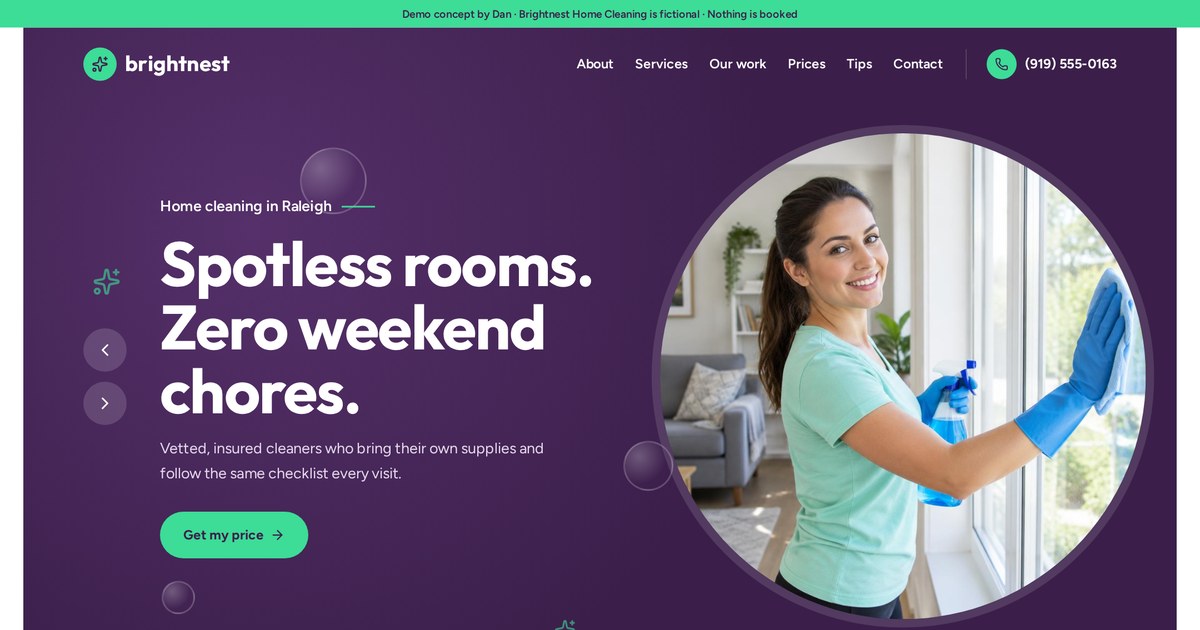
A live price builder turns a vague service into a specific offer: pick your rooms and extras, see the price instantly.
Open the live demoLower the first step
If your main offer is a big decision, give people a smaller first yes. A free roof check. A 15-minute call. A sample pack. A paid trial week. The small yes builds trust so the big yes feels natural.
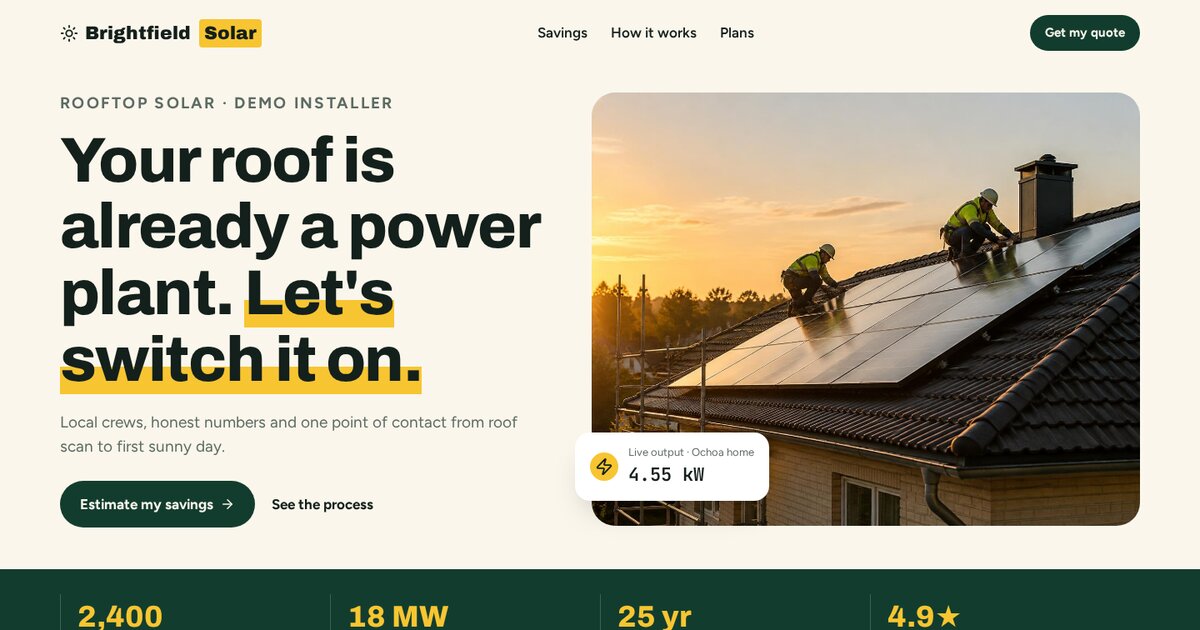
Solar is a big purchase, so the first ask is a savings estimate, not a contract. The calculator is the first small yes.
Open the live demoHonest urgency only
Fake countdown timers and "only 2 spots left" when there are fifty spots are tempting, and people can tell. They also break consumer protection rules in many countries. Real reasons are better: you only book four installs a week, the price changes next season, the cohort starts on a fixed date.
How to create a sales funnel, step by step
This is the process I follow on client projects, condensed. You can use it yourself, or use it to judge whoever you hire.
To create a sales funnel: define one customer and one offer, map every step on paper, write the copy, build the landing page and conversion step, set up tracking, connect follow-up emails or texts, test everything end to end, launch with a small budget, then improve the weakest step based on the numbers.
- Pick one customer and one offer. One. You can add more funnels later.
- Write down the numbers: sale value, close rate, capacity, budget.
- Map the funnel in boxes, including the "no" paths.
- Write the copy before designing: headline, problem, outcome, proof, offer, FAQ, button text.
- Wireframe each page in grey boxes and check the order makes sense.
- Design and build the pages, mobile first.
- Build the conversion step: form, quiz, calendar or checkout. Fewer fields wins.
- Write the thank-you page so people know exactly what happens next.
- Set up follow-up: confirmation, reminders, nurture sequence, internal alert to you.
- Install tracking: page views, form submits, bookings, purchases, with clear event names.
- Test as a real customer on a phone: every button, every email, every link.
- Launch with a small, controlled budget or a single traffic source.
- Review after a week or two: find the biggest drop-off and fix that first.
How long does it take?
A simple booking or lead magnet funnel can be designed, built and tested in one to two weeks when the offer and copy are clear. A full funnel with a quiz, multiple follow-up branches and CRM integration takes longer. The slow part is almost never the building. It's getting the offer and message right.
Your first funnel should be boring
Resist the urge to build a 12-step masterpiece. One page, one form, one confirmation, three follow-up messages. Get it working and measured. Then add the quiz, the upsell, the retargeting. Complexity you add later is cheap. Complexity you add first is expensive to debug.
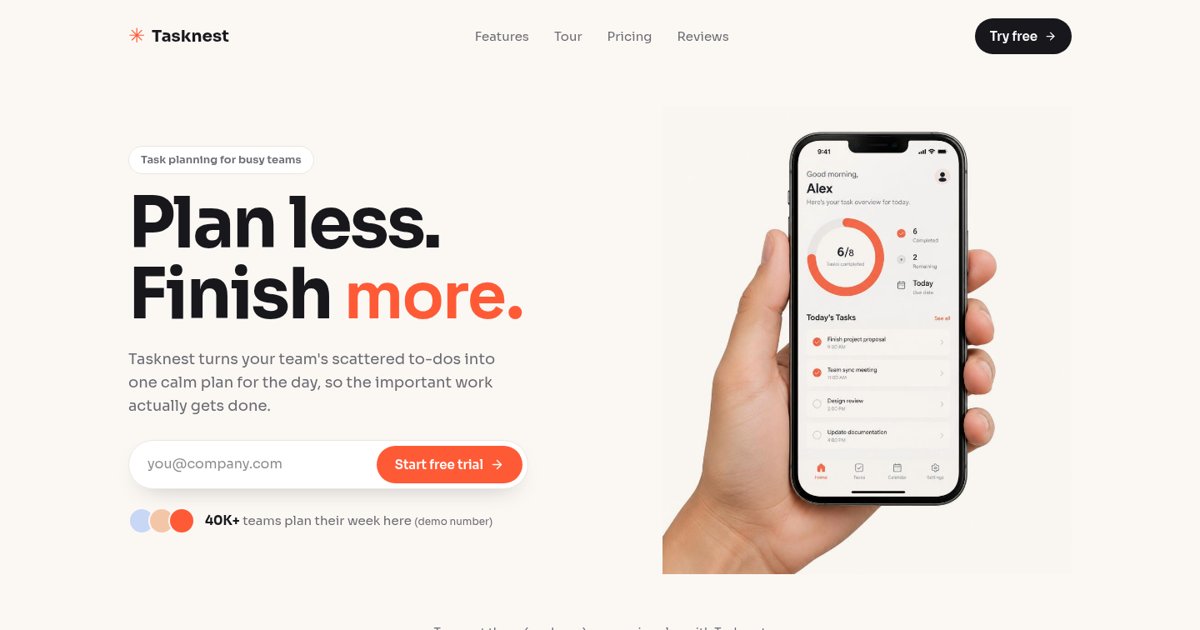
A focused sign-up page: one email field above the fold, features, proof, then pricing. Built to be the first step of a free-trial funnel.
Open the live demoTraffic sources and message match
A funnel without traffic is a shop with the lights off. But not all traffic is equal, and the page needs to match where people came from.
Funnel traffic usually comes from paid ads (Google, Meta, TikTok, LinkedIn), organic search, social media, email, partnerships and referrals. Message match means the page someone lands on repeats the exact promise, wording and visuals of the ad or link they clicked, so they instantly know they're in the right place.
| Source | Intent | Speed | Best funnel type |
|---|---|---|---|
| Google Search ads | High (they're searching) | Fast | Booking, quote, short lead form |
| Meta / TikTok ads | Low to medium (scrolling) | Fast | Quiz, lead magnet, offer page |
| Organic search (SEO) | Medium to high | Slow | Guide → lead magnet → booking |
| Email list | Warm | Instant | Offer page, webinar, upsell |
| Referrals | Very warm | Varies | Short booking page |
| Professional, considered | Medium | Webinar, application, B2B demo |
Hot traffic vs cold traffic
Someone who searched "emergency plumber near me" is hot. They want to call now. Give them a phone number and a short form, nothing else. Someone who saw a video while scrolling is cold. They weren't looking for you. They need a gentler first step, like a quiz or a useful freebie.
Sending cold traffic to a "book a call now" page is the most common funnel mistake I see. The conversion rate looks awful, the business blames the ads, and the real issue is that the ask was too big for how warm the visitor was.
Message match in practice
- The ad says "Free roof inspection in 48 hours". The headline says the same, not "Welcome to ABC Roofing".
- The ad shows a photo of a storm-damaged roof. The page shows a similar photo near the top.
- The ad targets one city. The page names that city.
- The ad promises a price. The page shows that price without making people hunt.
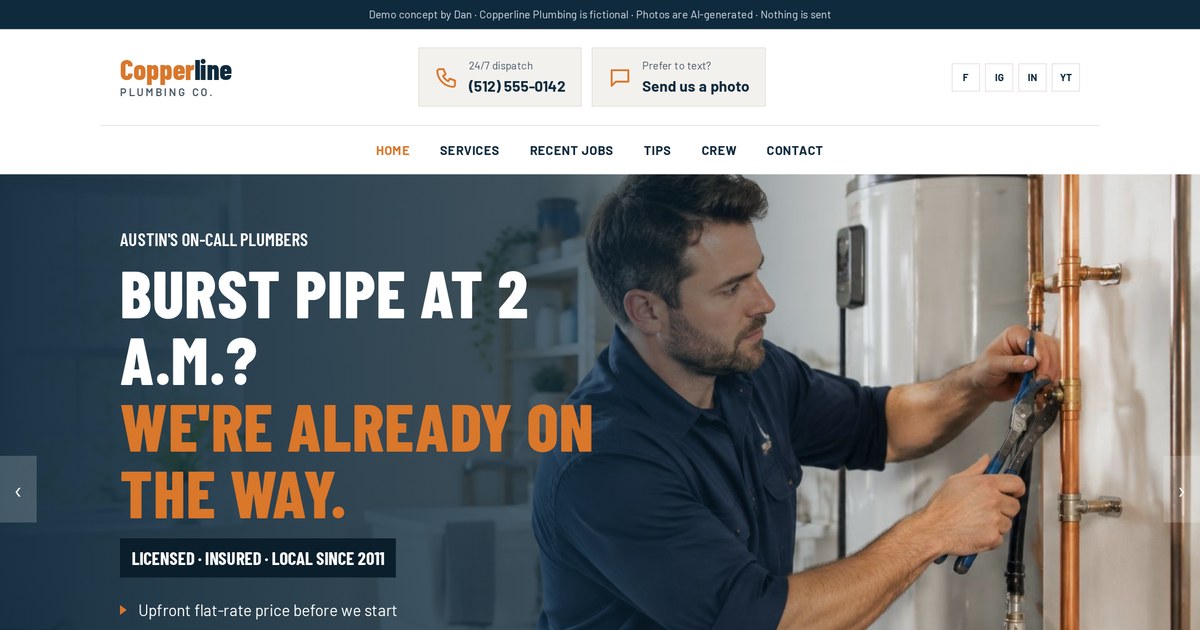
Emergency-first layout: phone number and quote form up top for hot "plumber near me" traffic.
Open the live demoDon't forget SEO as a funnel source
Organic search is slow to start but keeps paying. A helpful guide (like this one) brings in people at the Awareness stage. If the guide links to a relevant free tool or a booking page, it becomes the top of a funnel that doesn't charge you per click.
Opt-in and lead capture pages that convert
The opt-in page is where a visitor turns into a lead. It's usually the most important page in the whole funnel, and the most over-designed.
An opt-in (or lead capture) page asks a visitor for their contact details in exchange for something valuable: a quote, a guide, a discount, a result. High-converting opt-in pages have one clear headline, a specific benefit, a short form, visible trust signals, and no navigation or distractions.
The anatomy I use
- Headline that matches the ad and names the outcome.
- One or two lines explaining exactly what they get and how fast.
- The form, visible without scrolling on a phone.
- A button that says what happens ("Get my free quote"), not "Submit".
- A short trust line under the button: no spam, response time, privacy.
- Proof further down: reviews, logos, photos of real work, guarantees.
- FAQ answering the three questions that stop people filling it in.
How many form fields?
As few as you need to take the next step, and no fewer. Every field adds effort. But a field that qualifies the lead (like ZIP code for a local business, or budget for a premium service) can save you from wasting time on leads you can't serve. I usually start with name, phone or email, and one qualifying question.
| Field | Keep it? | Why |
|---|---|---|
| Name | Usually | Personalises follow-up |
| Email or phone | Yes, at least one | You can't follow up otherwise |
| Both email and phone | Only if you really call | Asking for both lowers sign-ups |
| ZIP / location | Local businesses | Filters out-of-area leads |
| Budget | Premium services | Filters, but lowers volume |
| Company size, job title | B2B only | Only if sales actually uses it |
Four fields only (name, phone, service, ZIP). The problem cards pre-fill the service field, so most visitors only type three things.
Open the live demoMulti-step forms
Breaking a long form into two or three short steps, starting with an easy question, often feels lighter than one big form. Once someone answers the first question, they're more likely to finish. I use this a lot for loans, insurance, and quotes.
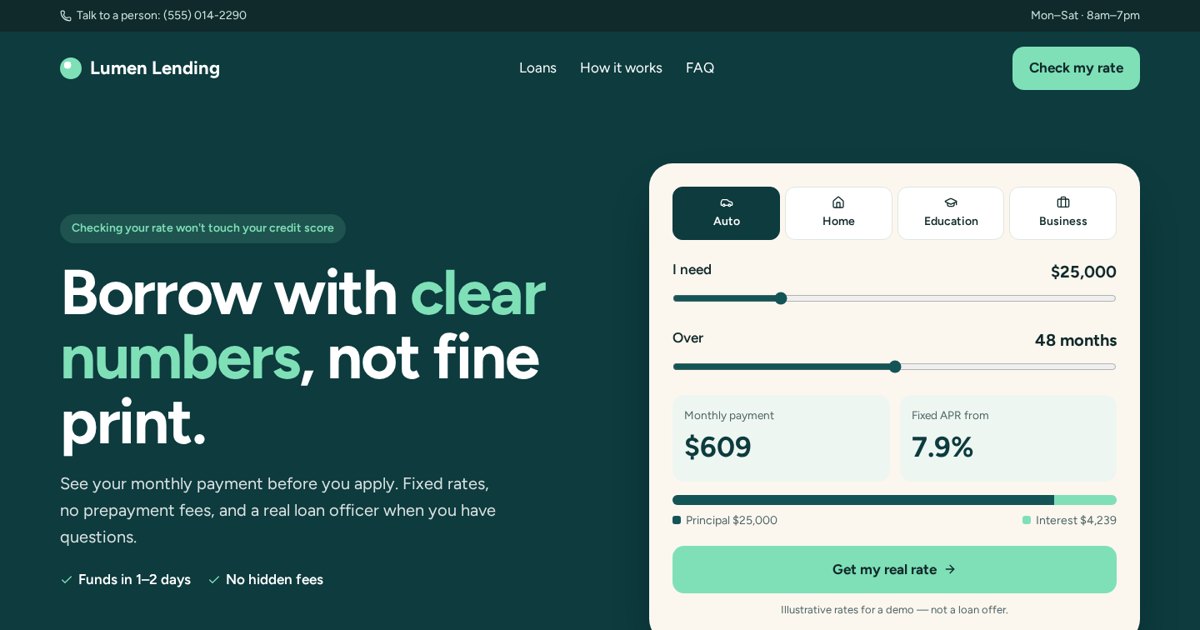
A 2-step "check your rate" form starts with the loan amount, the easy and interesting question, before asking for details.
Open the live demoQuiz and booking funnels
These are the two funnel types I build most for service businesses. Here's how they work, using my own live demo.
A quiz funnel asks visitors a few simple questions, then gives a personalised result and next step, which collects useful lead data along the way. A booking funnel takes visitors straight from a focused page to a calendar, then uses reminders to reduce no-shows. Many of my builds combine the two: quiz first, then booking.
Why quizzes work
People like being asked about themselves. A quiz feels like getting advice, not being sold to. And each answer segments the lead, so your follow-up can be specific: the homeowner with an active leak gets a same-day call, the one planning next year gets a gentle email series.
- Keep it to 3 to 6 questions. Every extra question loses people.
- Make the first question the easiest and most interesting.
- Use big tappable buttons, not dropdowns.
- Show progress ("Question 2 of 3").
- Ask for contact details just before the result, and explain why.
- Make the result genuinely useful, even if they don't buy.
Click through it: ad, opt-in, 3 quiz questions, booking calendar and follow-up preview. The side panel shows the tracking events, CRM tags and automations firing at each step.
Open the live demoBooking funnels
A booking funnel removes the back-and-forth of "when are you free?" The visitor picks a slot, gets a confirmation, and gets reminders. The page before the calendar should answer: what happens on this call or visit, how long it takes, what it costs, and who they'll talk to.
Fighting no-shows
- Instant confirmation email and text with the time in their timezone.
- A reminder the day before with a one-click reschedule link.
- A reminder about an hour before.
- If they miss it, an automatic friendly "want to rebook?" message.
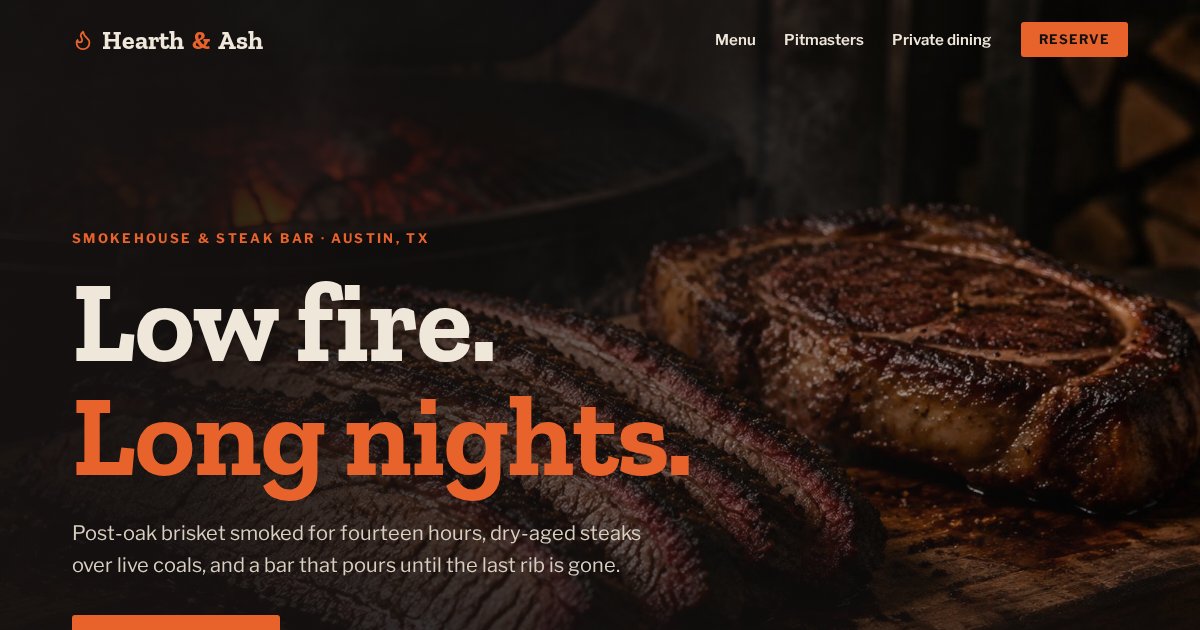
Booking funnels aren't just for services: guest count, date and time slots in a single bar make reserving a table fast.
Open the live demoSales pages, order forms and upsells
When the funnel ends in a purchase rather than a call, the sales page and checkout do the work a salesperson would normally do.
A sales page explains an offer in enough depth for someone to buy without talking to you. An order form or checkout collects payment with as little friction as possible. Upsells, order bumps and downsells are extra offers shown during or right after checkout to raise the average order value.
What a long sales page needs
- The promise: headline and subheadline focused on the outcome.
- The problem: show you understand their situation in detail.
- The solution: your offer, introduced as the way out.
- What's included: clear list, ideally with visuals.
- Proof: real results, reviews, case studies, credentials.
- Price and comparison: what it costs vs the cost of the problem or alternatives.
- Guarantee and risk reversal.
- FAQ handling every objection you've heard on sales calls.
- Repeated call to action at natural decision points.
Long pages work for considered purchases because buyers have many questions. Short pages work for simple, cheap or impulse purchases. The rule isn't "long beats short". It's "answer every question this buyer has, and nothing more".
Checkout friction
- Guest checkout. Forcing account creation loses buyers.
- Show the total, including shipping and taxes, early.
- Offer the payment methods your market actually uses (cards, wallets, local options).
- Keep trust signals near the pay button: secure payment, refund policy, support contact.
- Don't send people away from the checkout with extra links.
Upsells, order bumps and downsells
| Type | When it appears | Example |
|---|---|---|
| Order bump | On the checkout, as a tick box | Add a protective cover for a small extra |
| Upsell | Right after purchase | Upgrade to the annual plan and save |
| Cross-sell | In the cart or after purchase | People who bought this also got… |
| Downsell | After they decline an upsell | A smaller version at a lower price |
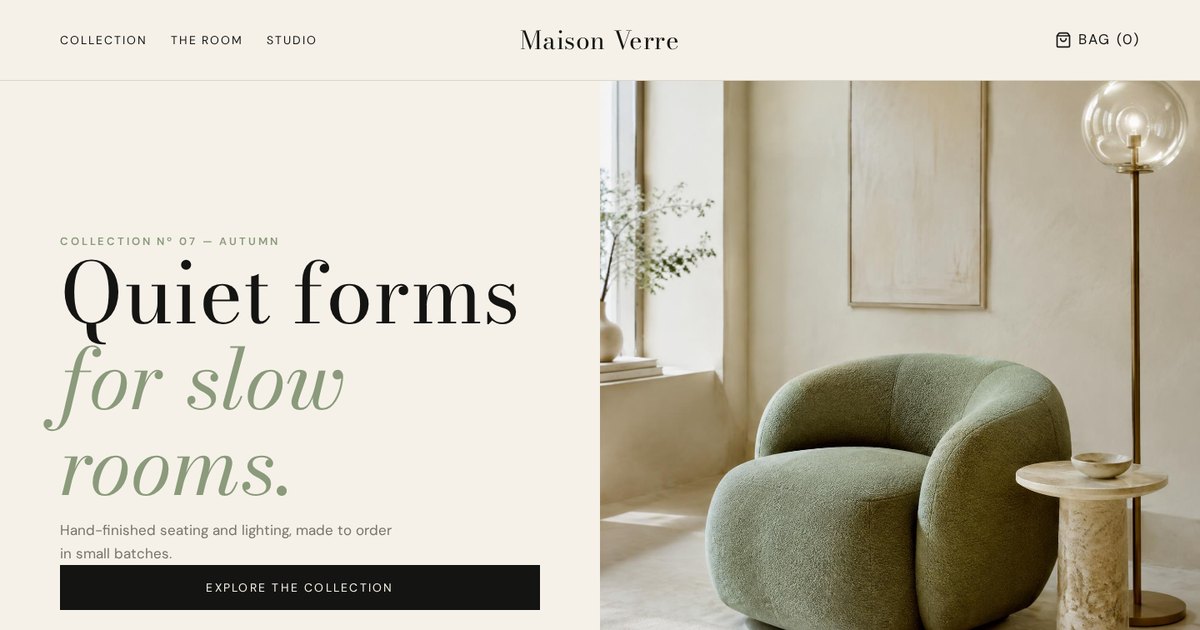
"Shop the room" dots and a slide-out bag are a gentle cross-sell: see the whole look, add the matching pieces in one click.
Open the live demoFunnel tools and builders compared
People ask me "which funnel software is best?" constantly. Honest answer: the one that fits your stack and that someone on your team will actually maintain.
Popular funnel builders include ClickFunnels and GoHighLevel (all-in-one funnel and CRM platforms), Webflow and WordPress (flexible website builders), Shopify (ecommerce), and custom-built funnels with AI-assisted tools like Lovable. All-in-one tools are fast to start; custom builds give more control over design, speed and tracking.
| Tool | Strengths | Trade-offs | Good fit for |
|---|---|---|---|
| ClickFunnels | Funnel templates, checkout, upsells built in | Templates can look alike; design limits | Info products, courses |
| GoHighLevel | CRM, SMS, email, calendars, pipelines in one | Learning curve; page design can feel dated | Agencies, local services |
| Webflow | Strong design control, fast hosting | Needs other tools for CRM and email | Brands that care about design |
| WordPress | Huge ecosystem, flexible | Plugins need maintenance and can slow pages | Content-heavy sites |
| Shopify | Best-in-class checkout for physical products | Less flexible outside ecommerce | Online stores |
| Custom build (e.g. Lovable) | Full control over design, speed, interactive tools | Needs a builder who knows funnels | Unique funnels, quizzes, calculators |
How I choose
- What does the business already use for CRM, email and payments? Don't fight the stack.
- Who will edit pages after launch? If it's the owner, pick something they can use.
- Does the funnel need interactive tools (quizzes, calculators, estimators)? Custom builds handle these best.
- How important is speed and unique design? Templates are fast, but competitors use the same ones.
All of the demos on my site, including the roofing funnel, are custom-built. That's how I can put live calculators, quizzes and pricing builders into pages and keep them fast on phones. For clients already invested in GoHighLevel or similar, I often design and build the front-end pages and connect them to their existing CRM.
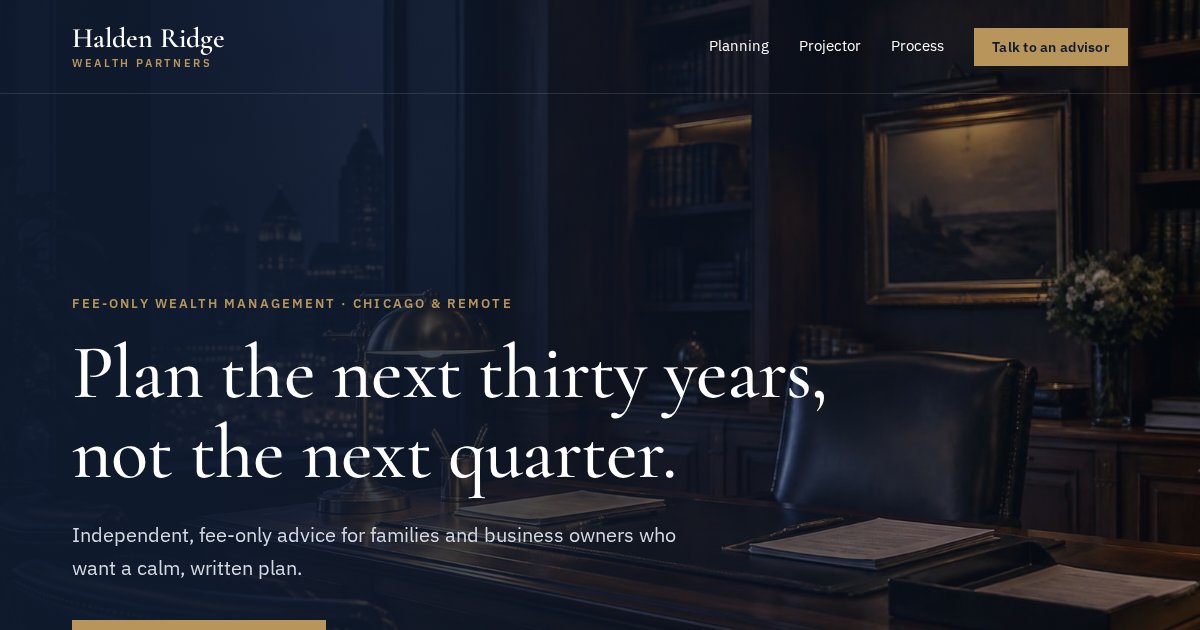
A retirement projector with sliders and a live chart: the kind of interactive tool that's hard to do in a template builder.
Open the live demoEmail and SMS follow-up sequences
Most leads don't buy on the first visit. Follow-up is where the funnel earns back what you spent getting them there.
Follow-up sequences are automated emails or text messages sent after someone takes (or doesn't take) an action in your funnel. They confirm, remind, educate, answer objections and invite the next step. A simple sequence is often 3 to 7 messages over one to two weeks, triggered by what the lead did.
The sequences almost every funnel needs
| Sequence | Trigger | Goal |
|---|---|---|
| Instant confirmation | Form, quiz or booking submitted | Reassure and set expectations |
| Speed-to-lead alert | New lead | Notify you or your team to call fast |
| Nurture | Opted in, didn't book or buy | Build trust, invite next step |
| Reminders | Booking made | Reduce no-shows |
| Win-back | Went quiet after a quote | Restart the conversation |
| Post-purchase | Bought | Onboard, request review, ask for referral |
Speed matters more than polish
For service businesses, the first person to respond often wins the job. An instant text that says "Thanks Sarah, this is Mike from Ridgeline, I'll call you within 15 minutes" beats a beautiful email sent the next morning. I always set up an internal alert so the owner knows the moment a hot lead arrives.
A simple 5-message nurture
- Right away: deliver what they asked for and say what happens next.
- Day 1: a short story or example of someone like them you helped.
- Day 3: answer the most common objection (usually price or timing).
- Day 5: show proof, like a before-and-after, review or case study.
- Day 7: a direct, friendly invitation to book or buy, with an easy reply option.
Respect the rules
Get clear permission, especially for text messages, make unsubscribing easy, and follow the rules where your customers live (they differ between the US, Europe and Asia). It's the right thing to do and it protects your sending reputation.
Tracking: pixels, events, UTMs and CRM tags
If you can't see what's happening at each step, you're guessing. This is the "under the hood" part most people never see, and the part I care about most.
Funnel tracking records what visitors do at each step so you can see where they drop off and which traffic actually produces customers. It usually combines analytics events (page view, form start, form submit, booking, purchase), ad pixels, UTM tags on links, and CRM tags or stages on each lead.
The events I set up on every funnel
| Event | Fires when | Tells you |
|---|---|---|
| page_view | A funnel page loads | How many people reached each step |
| cta_click | Main button clicked | Whether the page convinces people to start |
| form_start | First field touched | Interest vs friction in the form |
| lead | Form or quiz submitted | Your core conversion |
| booking | Appointment confirmed | Sales-ready leads |
| purchase | Payment completed | Revenue, by source |
UTM tags: knowing where leads came from
UTMs are little labels added to the end of a link, like ?utm_source=facebook&utm_campaign=storm-inspection. Your analytics and CRM can read them, so you know which ad, email or post a lead came from. Without them, everything shows up as "direct" and you can't tell what's working.
CRM tags and stages
Inside your CRM, every lead should carry tags (what they asked for, quiz answers, source) and sit in a stage (new, contacted, booked, quoted, won, lost). That's what lets follow-up be specific and lets you calculate real cost per customer, not just cost per lead.
Open the "Under the hood" panel as you click through: you'll see the events, tags and automations each step would fire.
Open the live demo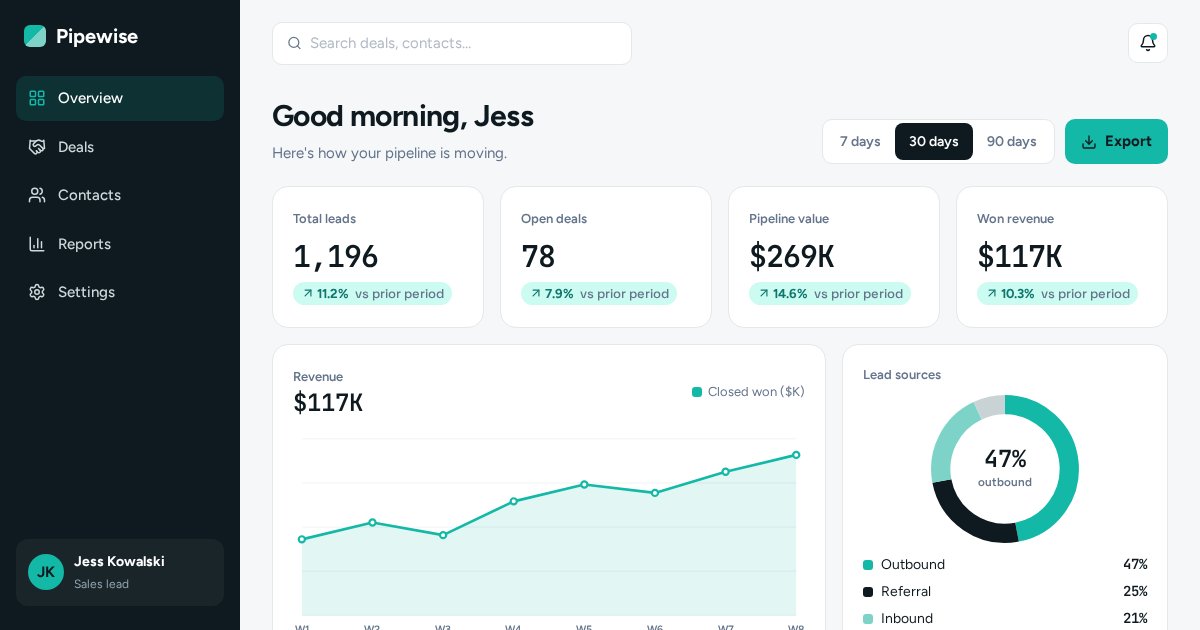
What the other end looks like: a pipeline dashboard where 7, 30 and 90-day views show leads moving through stages.
Open the live demoPrivacy and consent
Tracking must respect privacy laws and cookie consent rules in your visitors' regions. Collect what you need, explain it in your privacy policy, and give people choices where the law requires it.
Funnel math: conversion rates, cost per lead and analysis
You don't need to love spreadsheets. You need about five numbers and the habit of checking them.
Sales funnel analysis means measuring how many people move from each step to the next (the step conversion rate), what each lead and customer costs, and what each customer is worth. The step with the biggest drop-off, relative to what's normal for that kind of step, is usually the first thing to fix.
The five numbers
| Metric | Formula | Example (illustrative) |
|---|---|---|
| Click-through rate | Clicks ÷ impressions | 200 ÷ 10,000 = 2% |
| Landing page conversion | Leads ÷ visitors | 20 ÷ 200 = 10% |
| Cost per lead | Ad spend ÷ leads | $400 ÷ 20 = $20 |
| Close rate | Customers ÷ leads | 4 ÷ 20 = 20% |
| Cost per customer | Ad spend ÷ customers | $400 ÷ 4 = $100 |
These figures are made up to show the maths, not benchmarks. What matters is your cost per customer compared to what a customer is worth. If a customer is worth $1,000 over time and costs $100 to get, you have a healthy funnel worth scaling. If they cost $900, you have a problem to fix before spending more.
Reading the drop-offs
- Lots of impressions, few clicks: the ad or hook is the problem.
- Lots of clicks, few leads: the landing page or offer doesn't match the ad.
- Lots of form starts, few submits: the form is too long or confusing.
- Lots of leads, few bookings: follow-up is slow or the lead quality is low.
- Lots of bookings, few sales: the sales conversation or price needs work.
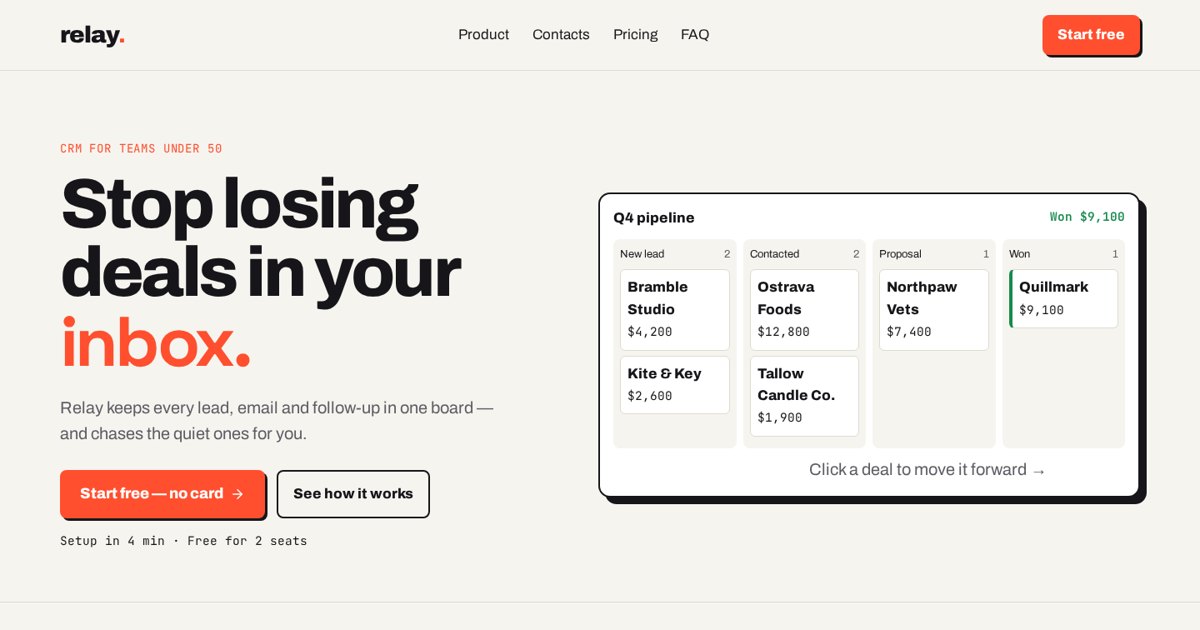
A clickable pipeline board shows the same idea visually: leads moving column to column, and where they pile up.
Open the live demoTesting and fixing a leaky funnel
Conversion rate optimisation (CRO) sounds technical. In practice it's careful observation, sensible guesses, and changing one thing at a time.
To fix a leaky funnel, find the step with the biggest drop-off, watch how real people use it (recordings, feedback, testing on your own phone), form one clear guess about why they leave, change that one thing, and compare results. Repeat. A/B tests help when you have enough traffic; with low traffic, make bigger, clearer improvements.
My leak-fixing checklist
- Does the headline match the ad or link they clicked?
- Can you understand the offer in five seconds on a phone?
- Is the main button visible without scrolling?
- Does the page load quickly on mobile data?
- Is there anything competing with the main action (menus, extra links, pop-ups)?
- Are the top three objections answered on the page?
- Is there real proof, close to the button?
- Does the form ask only what's needed?
- Does the thank-you page say what happens next?
- Does follow-up arrive within minutes?
When to A/B test (and when not to)
A/B testing means showing two versions to different visitors and seeing which wins. It's great with lots of traffic. With small traffic, tests take months and the results are mostly noise. For most small businesses I recommend fixing obvious problems first, then testing big ideas (a different offer, a different headline angle) rather than button colours.
High-impact things to test
- The offer itself (free inspection vs discount vs guarantee).
- The headline angle (problem-focused vs outcome-focused).
- Form vs quiz as the conversion step.
- One-step vs two-step form.
- Adding a calculator or estimator.
- Price shown vs "get a quote".
An instant estimator replaces "call us for a quote": a big, testable change to the conversion step itself.
Open the live demoSales funnel examples by industry
Here's how I'd shape a funnel for different kinds of businesses, with demos from my portfolio so you can click through the front end of each.
Sales funnels look different by industry: local services usually use ad → quote or booking page → fast call; B2B uses content or webinars → demo request → sales calls; SaaS uses landing page → free trial → onboarding emails → upgrade; ecommerce uses ad → product page → cart → upsell → post-purchase emails; coaching uses content → quiz or free call → program offer.
Local services (HVAC, plumbing, roofing, cleaning)
Path: Google or Meta ad → service landing page with a short quote form or estimator → instant text and call → on-site visit → quote follow-up → review request. Speed to lead is everything.
Front end of a local service funnel: estimate form above the fold, repair-or-replace slider, FAQ, sticky mobile button.
Open the live demoB2B sales funnel
B2B purchases involve several people and longer timelines. Path: LinkedIn or search → useful guide or webinar → email nurture → demo or consultation request → proposal → follow-up. Case studies and clear pricing ranges do a lot of the selling before the first call.
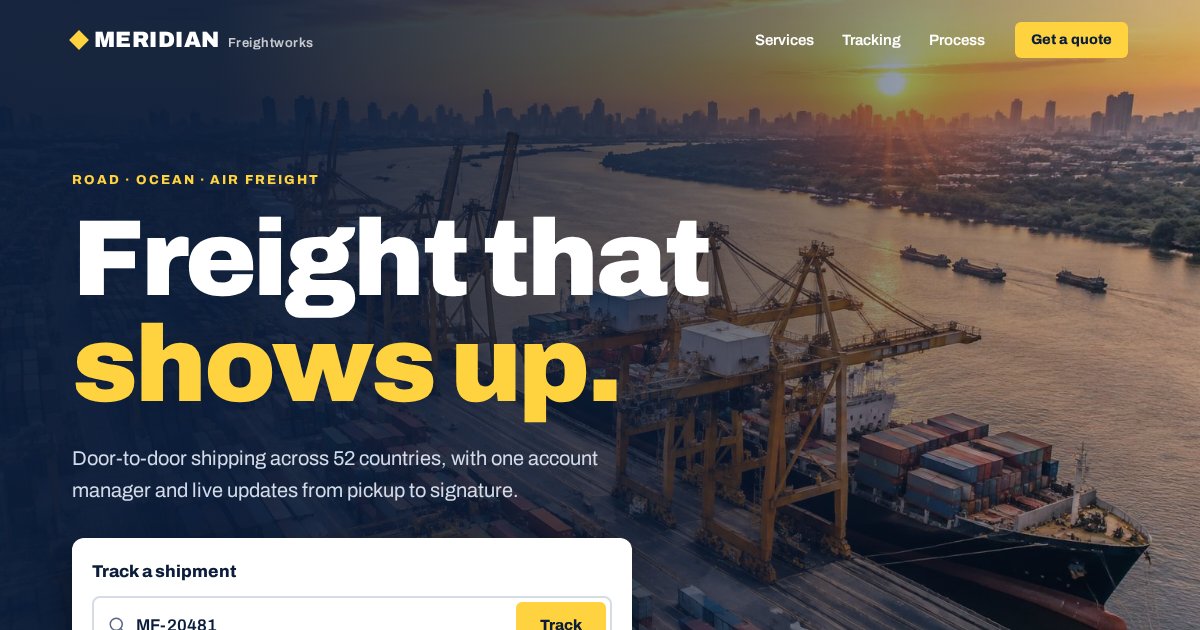
A freight quote calculator gives B2B buyers a number before they talk to sales, which qualifies them on both sides.
Open the live demoSaaS funnel
Path: landing page → free trial or freemium sign-up → onboarding emails guiding people to the "aha" moment → upgrade prompt → retention. The funnel continues inside the product.
Email-first sign-up, feature tabs and a monthly/yearly toggle: the top of a free-trial funnel.
Open the live demoEcommerce funnel
Path: ad or search → product or collection page → cart with order bump → checkout → post-purchase upsell → abandoned cart and replenishment emails.
Search, quick view, currency switch and slide-out cart keep shoppers in a single flow.
Open the live demoCoaching and wellness
Path: social content or ads → quiz or free discovery call → program page → booking → onboarding. Trust is the product, so personality and specifics matter.
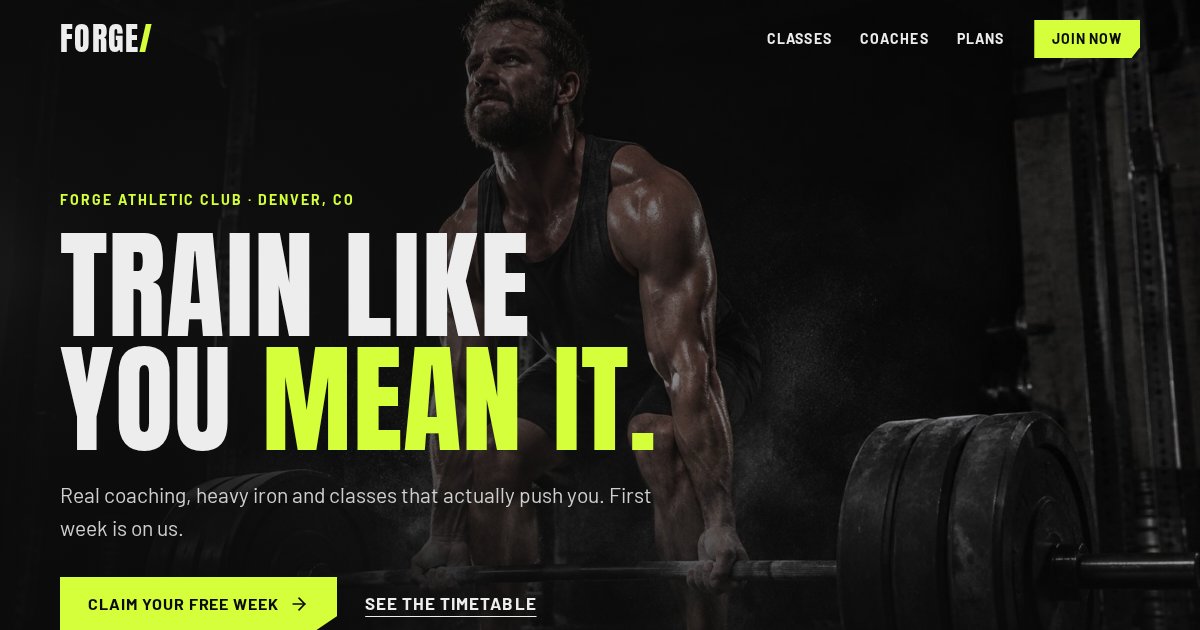
Class timetable and membership plans: a trial-class booking is the natural first step of a gym funnel.
Open the live demoReal estate and finance
Path: ad or search → calculator or property search → saved search or rate check → agent or advisor call. Calculators turn browsers into leads because people want their number.
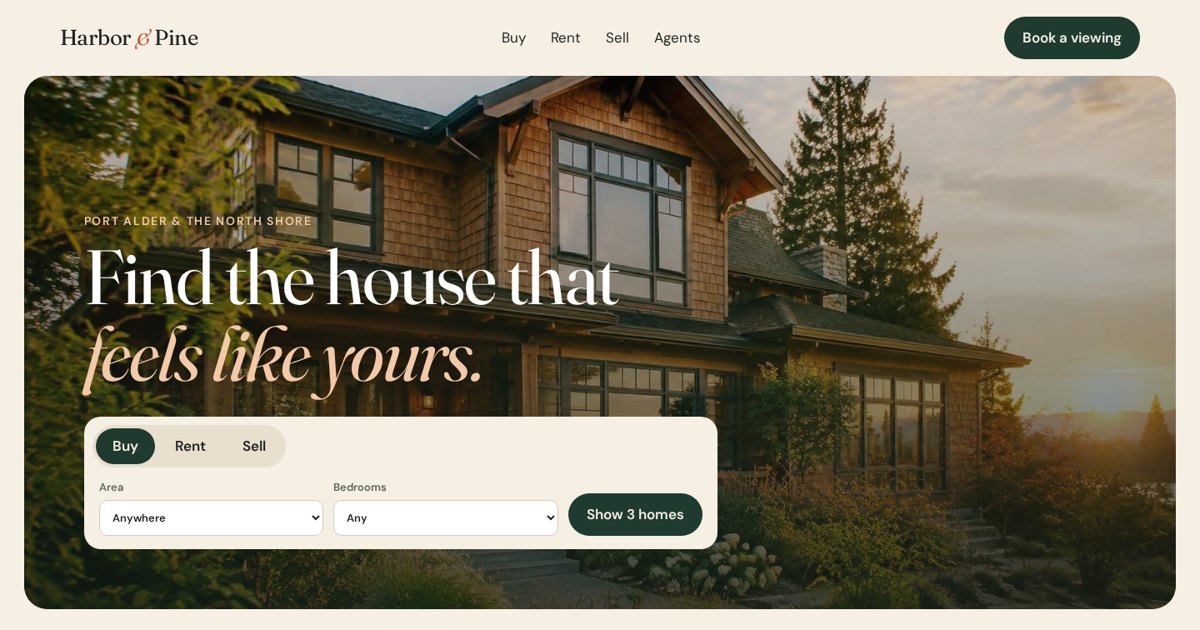
Listings filters, favourites and a mortgage estimator: three natural opt-in points in one page.
Open the live demoNon-profits
Path: story-led content → donation page with suggested amounts and a visible goal → thank-you and impact updates → monthly giving ask. Retention matters more than anywhere.
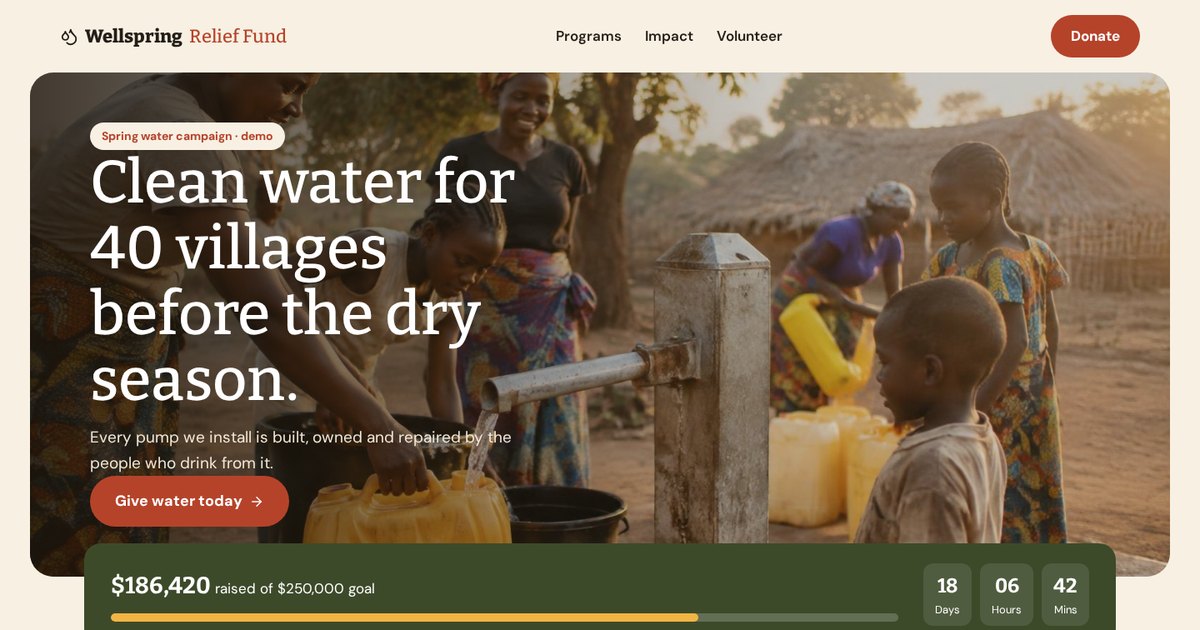
A live donation builder and campaign goal bar make giving specific and visible.
Open the live demoFunnel mistakes, costs and how to choose a funnel builder
To finish, the mistakes I see most, what drives the cost of a funnel, and how to choose someone to build yours (even if it's not me).
The 10 funnel mistakes I see most
- Sending paid traffic to the homepage.
- An offer that's vague or identical to every competitor.
- Asking cold traffic for a big commitment.
- Headline that doesn't match the ad.
- Too many choices and links on the conversion page.
- Forms that ask for everything up front.
- No follow-up, or follow-up that arrives a day later.
- No reminders on bookings.
- No tracking, so nobody knows which step leaks.
- Changing everything at once, then not knowing what worked.
What a sales funnel costs
Costs vary widely by scope, so I'd rather explain what drives the price than throw out a number that won't fit your project. The main factors are below. Ask any builder (me included) for a written scope that lists each piece.
| Cost driver | Simpler | More involved |
|---|---|---|
| Number of pages | One landing page + thank-you | Multiple steps, upsells, variants |
| Conversion step | Short form | Quiz, calculator, booking, checkout |
| Copywriting | You supply it | Written from scratch with research |
| Follow-up | Confirmation + 3 emails | Branching email + SMS sequences |
| Tracking & CRM | Basic analytics | Full events, pixels, CRM pipeline |
| Ongoing | One-time build | Monthly testing and improvements |
Separately, budget for running costs: software subscriptions (CRM, email, SMS, hosting) and traffic (ad spend, or time for content and SEO).
How to choose a funnel builder
- Ask to click through funnels they've built, not just see screenshots.
- Ask how they'll track each step and what numbers they'll report.
- Ask what happens after the lead submits. If they only talk about pages, they're a page designer, not a funnel builder.
- Check they write (or seriously edit) copy, not just design.
- Make sure you'll own your pages, domain and data.
- Look for someone who asks about your offer and customers before talking about tools.
Want a funnel planned around your offer and your customers? Email me what you sell and who buys it, and I'll sketch the first map.
Email meMy funnel launch checklist
- One customer and one offer, described in one sentence
- Funnel mapped on paper, including the "no" paths
- Headline matches the ad or link that sends traffic
- Main button visible without scrolling on a phone
- Form asks only for what's needed, with clear button text
- Thank-you page explains exactly what happens next
- Instant confirmation message to the lead
- Instant alert to you or your team
- Reminders set up for bookings
- Nurture sequence for leads who don't act
- UTM tags on every traffic link
- Events tracked for each step, up to the sale
- Tested end to end on a real phone
- Privacy policy and consent in place
- A weekly time set aside to review the numbers
Funnel terms in plain English
- A/B test
- Showing two versions of a page or message to different visitors to see which performs better.
- Abandoned cart
- When a shopper adds items but leaves before paying; often followed up by email.
- AIDA
- Attention, Interest, Desire, Action: a classic model for persuasive copy.
- Automation
- A message or action that runs on its own when a trigger happens.
- Average order value
- Total revenue divided by number of orders.
- BOFU
- Bottom of funnel: content and offers for people ready to buy.
- Bounce rate
- Share of visitors who leave without doing anything else.
- Call to action (CTA)
- The button or line telling visitors what to do next.
- Close rate
- Share of leads who become customers.
- Cold traffic
- People who don't know you yet.
- Conversion
- When a visitor takes the action you want.
- Conversion rate
- Conversions divided by visitors, as a percentage.
- Cost per lead (CPL)
- What you spend to get one lead.
- Cost per acquisition (CPA)
- What you spend to get one customer.
- CRM
- Customer relationship management software that stores leads, stages and history.
- CRO
- Conversion rate optimisation: improving the share of visitors who convert.
- Cross-sell
- Offering a related product alongside the one being bought.
- Customer lifetime value
- Total a customer is worth to you over the whole relationship.
- Downsell
- A smaller, cheaper offer shown after someone declines a bigger one.
- Drop-off
- The share of people who leave between two funnel steps.
- Event
- A tracked action, like a form submit or purchase.
- Flywheel
- A model where happy customers drive new ones through referrals and reviews.
- Funnel map
- A diagram of every step, page and message in a funnel.
- Hot traffic
- People who already know or are actively searching for you.
- Landing page
- A single page with one goal, often the entry to a funnel.
- Lead
- Someone who has shared contact details or shown buying interest.
- Lead magnet
- A free, useful item offered in exchange for contact details.
- Message match
- Keeping the page's promise and wording consistent with the ad or link clicked.
- MOFU
- Middle of funnel: content for people comparing options.
- Nurture sequence
- A series of messages that build trust over time.
- Opt-in
- When someone agrees to give details or receive messages.
- Order bump
- A small add-on offered on the checkout page.
- Pipeline
- The stages leads move through on the way to a sale.
- Pixel
- A snippet of code that reports visitor actions to an ad platform.
- Qualified lead
- A lead who fits your ideal customer and is likely to buy.
- Quiz funnel
- A funnel that uses a few questions to personalise the result and offer.
- Retargeting
- Showing ads to people who visited before but didn't act.
- Risk reversal
- Guarantees or terms that reduce the buyer's risk.
- Speed to lead
- How fast you respond to a new lead.
- Thank-you page
- The page shown after a conversion, explaining what happens next.
- TOFU
- Top of funnel: content for people just discovering a problem.
- Tripwire
- A low-priced first offer that turns a browser into a buyer.
- Upsell
- An upgrade or bigger offer shown during or after purchase.
- UTM
- Tags added to a link to record the source, medium and campaign.
- VSL
- Video sales letter: a video that presents an offer, usually followed by checkout.
Frequently asked questions
What is a sales funnel in simple terms?
It's the path someone takes from first hearing about you to buying from you, designed step by step so each step leads clearly to the next.
What are the 5 stages of a sales funnel?
Awareness, Interest, Decision, Action and Retention. Some models use four stages or name them differently, but the journey is the same.
Is a sales funnel the same as a website?
No. A website serves many visitors with many goals. A funnel guides one type of visitor toward one purchase, often across several pages and follow-up messages.
What's the difference between a sales funnel and a marketing funnel?
The marketing funnel covers getting attention and generating leads. The sales funnel covers turning those leads into customers. In small businesses they're usually one connected path.
Do small businesses need sales funnels?
If you rely on getting new customers online, yes. Even a simple funnel (one landing page, one form, three follow-up messages) is better than an accidental path with no follow-up.
What's the best type of funnel for a local service business?
Usually a booking or quote funnel, or a short quiz funnel that leads to booking. Speed of response and reminders matter as much as the page.
How long does it take to build a sales funnel?
A simple funnel can take one to two weeks once the offer and copy are clear. Larger funnels with quizzes, branching follow-up and CRM work take longer.
Which software is best for building funnels?
It depends on your existing tools and who will maintain the pages. All-in-one platforms are fast to start; custom builds give more control over design, speed and interactive features.
What is a good funnel conversion rate?
It varies a lot by industry, traffic source and offer. Compare your own steps against each other and over time rather than chasing someone else's benchmark.
How do I know where my funnel is leaking?
Track each step (page view, form start, lead, booking, purchase) and look for the largest drop between two steps. Then watch real people use that step.
Can SEO be part of a sales funnel?
Yes. Helpful articles bring in people at the awareness stage. Link them to a relevant free tool, guide or booking page and the article becomes the top of your funnel.
Do you build sales funnels?
Yes. I design and build landing pages and full funnels: pages, quizzes, calculators, booking steps, follow-up and tracking. Email dan@admusketeers.com with what you sell and who buys it.
Leads coming in, but not enough sales?
Let's build the funnel.
I design and build landing pages and full funnels: the pages, the quiz or calculator, the booking step, the follow-up and the tracking. Tell me what you sell.